
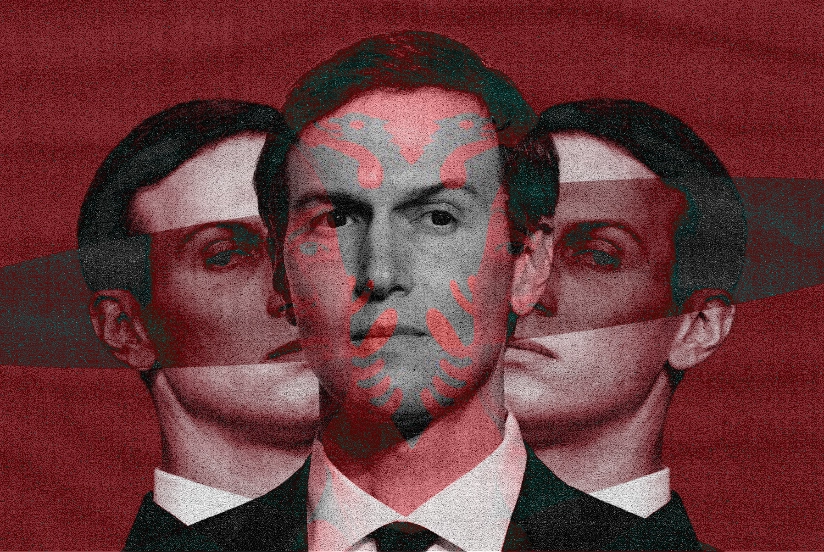
In 2021, Jared Kushner and Ivanka Trump swam ashore on Sazan, a rocky island off the Albanian coast, and fell in love with it. Five years later, that holiday romance has helped push a small Balkan nation toward open revolt. Kushner’s story, in fact, offers the clearest window into an administration where public power and private profit have become almost impossible to separate.
How to buy a coastline in three easy steps
First, the law had to change. In February 2024, Albania’s parliament lifted the ban on building in protected areas, conveniently freeing up the Vjosa-Narta delta, a flamingo stopover beside the very beach the Kushners adored. Next came the paperwork. On 30 December 2024, seven weeks after Donald Trump won re-election, Edi Rama’s government granted strategic investor status to Atlantic Incubation Partners, a firm tied to Kushner’s Affinity Partners, for a €1.4bn resort on Sazan and the Zvërnec coast. That status, as the EU’s own progress report observes, waves big investors past competitive tenders. Finally came the land, and this is where the story gets colourful.
Meet the neighbours
According to The Wall Street Journal, one key seller was Artur Shehu, a suspected gangster who fled to Miami after a gunfight at his bar. Part of his family’s claim to the land, a court found, bizarrely rested on an Ottoman-era deed on which an archivist had helpfully swapped the real owner’s name for a Shehu. In June, prosecutors arrested him as an alleged member of a drug gang. He denies it, although decades of investigations across Europe make that a tough sell. Considering that Albanian clans now run much of Europe’s cocaine trade and wash the proceeds through property, buying beachfront here without asking hard questions resembles buying a Rolex in a car park and acting shocked when it stops ticking.
Affinity, for its part, insists it does not lead the project. Excavators arrived regardless in late April, clearing pines and stringing barbed wire across public beaches while local officials argued over whether any permits existed.
The flamingos bite back
Albanians, who have watched 600,000 compatriots emigrate since 2011, did not take kindly to being fenced off their own shoreline. By June, thousands were marching on Rama’s office under banners reading “Albania is not for sale”, and the Flamingo Revolution became the most sustained challenge to his 13-year rule. Rama replied that the project would never stop while he remained in office, a promise that increasingly sounds like a countdown. By October, students had joined, Molotov cocktails were flying in central Tirana, as Brussels warns that Albania’s EU accession could suffer.
A cabinet in handcuffs
Meanwhile, Albania’s anti-corruption prosecutors opened an investigation into the delta’s lost protection, the skipped tenders and the origin of the money used to buy land titles. Their wider net keeps filling up. Tirana’s mayor has sat in detention since February 2025, the former deputy prime minister faces charges over €200m in contracts, and in September the intelligence chief was placed under house arrest on suspicion of leaking secrets to organised crime. Each denies wrongdoing, and Rama insists none of it touches him. In reality, he essentially traded his domestic legitimacy for privileged access to Washington, and that bargain is now coming due.
Serbians will recognise the plot. In Belgrade, a special law cleared the way for a Kushner development, prosecutors then charged a minister with forgery, and Kushner quietly walked away. The pattern, however, is consistent: laws bend, prosecutors follow, and the locals inherit the mess.
The account in Abu Dhabi
Yesterday, the plot thickened absurdly. In an excerpt from his new book Princes and Thieves, published by Vanity Fair, investigative journalist Matthew Cole reports that Dutch military intelligence stumbled onto screenshots from Jared Kushner’s iPhone sitting on Russian military intelligence servers in late 2017. Exploiting the same vulnerability, the Dutch then watched his screen themselves in early 2018, and what they saw was remarkable.
According to Cole, Kushner had signing authority over an account at First Abu Dhabi Bank, formally held by an Emirati government-funded charity, into which Saudi and UAE leaders had poured around $750m to bankroll unofficial diplomacy. Every dollar reportedly arrived via an Azerbaijani bank. Some banks there apparently offered a handy service: take riyals and dirhams, pay out dollars from a separate account, pocket a 6 to 7% commission, and leave the money’s origins conveniently blurred.
Cole goes further, alleging that by spring 2018 Mohammed bin Zayed had routed roughly $1bn more through Azerbaijan to an account at the Bank of Israel intended for Kushner, with former US ambassador David Friedman acting as go-between.
The timing is what should make readers choke on their coffee. In 2017 and 2018, Kushner was no private investor. He was a senior White House adviser running Middle East policy, so a foreign-funded account under his signature would mean Gulf monarchs were financing the president’s son-in-law while he negotiated with them.
Kushner’s lawyer says his client knew nothing about the accounts and broke no laws, and Friedman denies it too.
Yes, he denies it, but his track record would indicate otherwise: this is the same man who collected $2bn from the Saudi sovereign wealth fund shortly after leaving government, and who has kept raising Gulf money while serving as Trump’s envoy.
To be fair, no banking documents have been published, and nothing yet ties the Azerbaijani state itself to the transfers. Still, if even half of Cole’s account holds up, Congress has some urgent questions to ask, and the Russians, rather awkwardly, may have known the answers for eight years.


Leave a Reply