
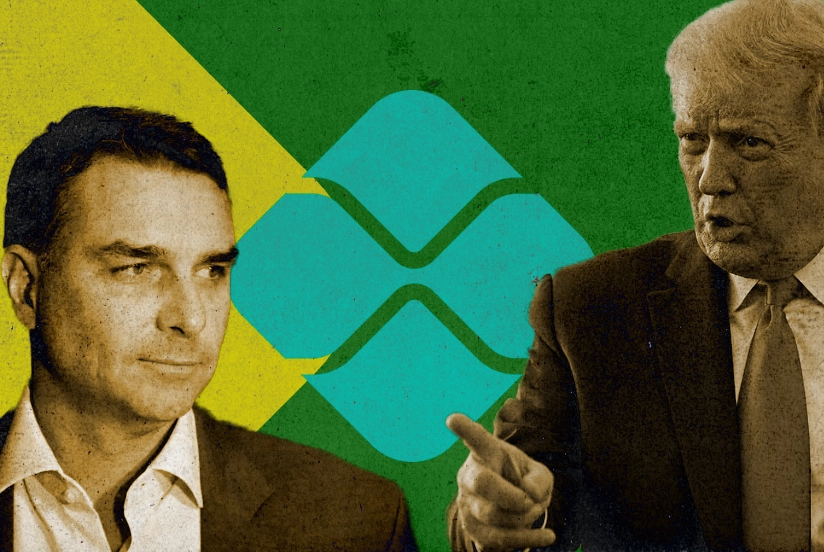
When Brazil’s Central Bank launched PIX in 2020, it had no intention of picking a fight with Washington. Five years later, the world’s most successful public payment system sits at the centre of a trade dispute, a geopolitical standoff, and a presidential election — with the Bolsonaro family caught on the wrong side of all three.
Brazil is a country that agrees on almost nothing. Its politics are fractured along lines of class, religion, race, and culture so deep that a shared conversation sometimes feels impossible. Yet there is one institution — a payment app, of all things — that cuts across all of it. From ice cream vendors on Ipanema beach to helicopter dealers in São Paulo, PIX is simply how Brazilians move money.
PIX registered over $7 trillion in transactions last year, and a hundred and seventy-eight million users out of a population of two hundred and thirteen million. It is, by any meaningful measure, one of the most successful pieces of public digital infrastructure ever built.
The American Complaint
In July 2025, the Office of the United States Trade Representative opened a formal investigation into PIX under Section 301 of the Trade Act of 1974. The specific charge: that Brazil’s Central Bank, by simultaneously regulating and operating PIX, creates an unfair competitive advantage against American payment companies.
Visa, Mastercard, and big tech firms with payment arms — Google, Meta — all operate in Brazil and are all subject to a regulatory environment that compels them to integrate with PIX. Because PIX is free for individuals and near-free for businesses, the implicit argument is that American firms are being denied the revenue they would otherwise extract from transaction fees.
The investigation concluded in June 2026 with a proposal to impose a 25% tariff on Brazilian goods. The USTR’s language was remarkably candid: Brazil, it stated, “imposes overly broad restrictions on the transfer of personal data outside Brazil” and “engages in unfair practices with respect to electronic payment services, including advantaging its government-developed electronic payment services.”
The framing is worth pausing on. A country building public infrastructure for its own citizens is characterised, in the language of American trade policy, as a violation of fairness.
Mourning a Lost Revenue Stream
Strip the legal language away and the picture considerably sharpens. PIX threatens a specific economic model: the extraction of fees from payment flows in emerging markets, mediated by American private infrastructure. Visa and Mastercard profit from every swipe.
Zelle, the closest American equivalent to PIX, is a private network owned by a consortium of the largest U.S. banks, including JPMorgan Chase, Bank of America, and Wells Fargo. FedNow, the Federal Reserve’s own instant payment system, launched in 2023 to tepid adoption — not one major American bank joined voluntarily.
The contrast with PIX is uncomfortable. America’s payment infrastructure, despite the wealth and technological sophistication of its private sector, could not produce what Brazil’s Central Bank built. PIX became a global model, studied by central banks from Southeast Asia to Sub-Saharan Africa.
That reputational weight carries geopolitical consequence. A Brazilian-designed payment architecture spreading through BRICS nations — potentially reducing the volume of dollar-denominated transactions — represents a second, longer-run anxiety for Washington.
The possibility of PIX Internacional integrating with BRICS payment systems directly challenges the dollar’s role as the de facto currency of global trade settlement. Trump has been explicit on this point, threatening 10% tariffs on any nation pursuing alternatives to the dollar. Thus, the PIX investigation and the BRICS anxiety are not separate stories.
The Vassals
Into this context walks the Bolsonaro family, and the picture becomes both more complex and more embarrassing.
In late May 2026, Senator Flávio Bolsonaro travelled to Washington, met with Donald Trump, J.D. Vance, and Marco Rubio, and returned to Brazil claiming he had personally intervened on behalf of Brazilian industry.
Days later, the USTR published its tariff proposal — with PIX listed among Brazil’s abusive practices. Flávio quickly posted a video insisting he had told Trump not to tax Brazilian companies. The choreography was transparent and the result was self-defeating: a man arguing he has influence over the American president, immediately contradicted by the American president.
His brother Eduardo went further. Appearing in a video circulated on Brazilian social media, Eduardo Bolsonaro suggested that the Zelle platform — a privately-owned American banking network with a well-documented fraud problem, responsible for $210 million in consumer losses in 2023 alone — could function as an adequate replacement for PIX.
The proposal was received as what it was: an endorsement of Brazilian financial infrastructure’s replacement by American private interests, offered voluntarily, by a Brazilian politician, while lobbying in Washington.
President Lula, at a public event in Catalão, chose his words with surgical precision. “These sons of Bolsonaro are, in truth, vendilhões da pátria” — sellers of the homeland — “who went to ask a foreign country to interfere in Brazilian decisions.” The charge is harsh. It is also, on the available evidence, not entirely wrong.
Do As We Say, Not As We Do
There is a broader principle at work here, one that extends well beyond PIX. The United States has pursued a consistent pattern of challenging domestic digital infrastructure built by emerging economies.
Indonesia faced trade complaints when its payment regulations disadvantaged Visa, Mastercard, and Amex. China’s UnionPay was treated as a market distortion. The common thread is not the violation of any agreed international rule, but the construction of public, low-cost, sovereign infrastructure that reduces dependence on American private networks.
What the USTR investigation reveals, in its own language, is that digital sovereignty is a right reserved for the powerful. When the United States restricts data flows to foreign servers on national security grounds, that is legitimate sovereign governance. When Brazil does the same, it is an unfair trade barrier. Thus, the asymmetry is precisely the logic of the arrangement.
Brazil isn’t being punished for breaking rules. It is being punished for refusing to remain a site of passive extraction — for building something that works, that others want to copy, and that competes on merit with private American alternatives. That is the actual offence.
The Ballot Box Remembers
The October 2026 presidential election will turn, as Brazilian elections always do, on many things simultaneously. Security, inequality, the economy, the exhaustion of polarisation.
Lula’s room to grow is limited in a country divided almost exactly down the middle. But the PIX episode has done something structurally important: it handed Lula the language of national sovereignty at the precise moment his opponent was photographed in Washington asking a foreign government to intervene in Brazilian affairs.
Flávio Bolsonaro entered this moment needing to consolidate the anti-PT vote while reaching toward the centre. He has instead reminded every Brazilian who uses PIX — which is to say, nearly every Brazilian — that there exists a political family willing to trade that infrastructure away for proximity to foreign power. In a country that built something the world envies, that is an extremely difficult position to defend.


Leave a Reply