
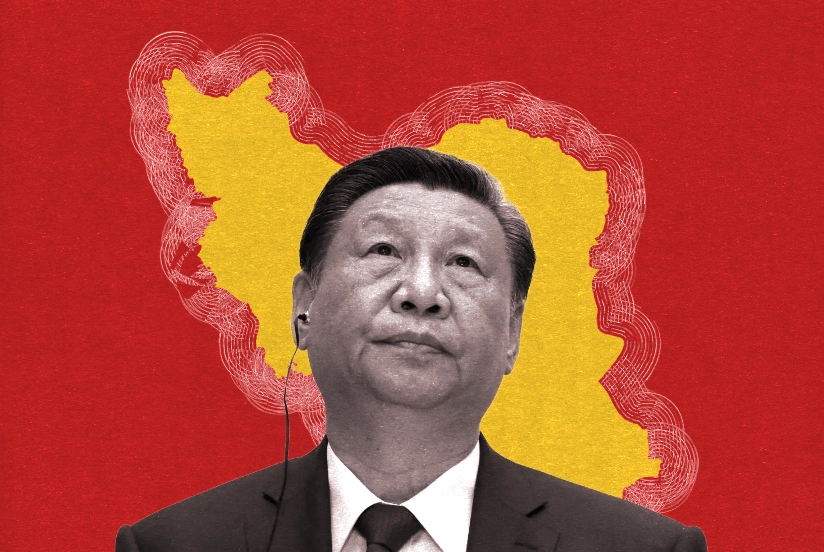
When American missiles struck Tehran on February 28th, the world scrambled for a response. China’s came quickly, and it was conspicuously measured, the posture of a power with no interest in being pulled into the room. Sure enough, Foreign Minister Wang Yi declared that “might does not make right” and that the “world had regressed to the law of the jungle”. And then, essentially, nothing apart from words, envoys, and a bland five-point ceasefire proposal co-signed with Pakistan that nobody paid much attention to.
China watched the United States assassinate Iran’s Supreme Leader, destabilise the Gulf, and send oil markets into convulsions — and its primary response was to observe carefully and wait. Understanding why tells you a great deal about where Chinese power actually stands, and where it intends to go.
The Comfortable Narrative, and Its Limits
The instinctive read in many Western capitals is that this war is a gift to Beijing. America is bogged down again in the Middle East, burning through munitions, alienating allies, and handing China a narrative about hegemonic decline on a silver platter. There is truth in all of that. China and Russia, sitting on the sidelines, appear to be following a cold strategic calculation: why interrupt a war waged by your adversary as it gets stuck in an expensive quagmire?
In Beijing’s policy circles, the old Napoleon maxim has found a receptive audience. “Never interrupt your enemy when he is making a mistake.” Letting Washington exhaust itself requires remarkably little effort.
However, this is not so simple once you look at the economics. China imports more crude oil than any other country, with roughly 70 percent of its supply coming from overseas and about one-third of that passing through the Strait of Hormuz. It is a structural vulnerability the war has exposed in real time, with gasoline prices inside China already up roughly ten percent since hostilities began.
China is hardly insulated from a global crisis of this magnitude. A prolonged conflict damaging Gulf energy infrastructure translates directly into domestic economic pressure, and that matters for a government whose legitimacy has rested on delivering continued prosperity for the past thirty years.
Additionally, Beijing carried a significant problem into this crisis well before the Strait of Hormuz shut. The Chinese economy has been in deflation for more than three years, and deflation erodes precisely the resilience needed to absorb a major global energy shock.
The Iran war did not create China’s economic fragility, though it is stress-testing it during a difficult moment. Consumer demand is weak, the real estate sector continues its structural decline, and a record trade surplus of $1.2 trillion last year, which contributed up to a third of GDP growth, now faces serious erosion if global demand buckles under the weight of higher energy costs.
The Cautious Opportunist
So Beijing is neither winning nor losing in any straightforward sense. A more accurate description, offered by analysts at the Middle East Institute, is that China is a cautious opportunist operating within clear constraints, preserving flexibility while avoiding entanglement in a conflict it cannot control.
That framing captures something important. China’s relationship with Iran was always more transactional than strategic. Tehran does not occupy the central position in China’s Middle East strategy that many observers assume. Beijing’s deeper commercial relationships are with Gulf states — Saudi Arabia and the UAE — whose bilateral trade with China dwarfs that with Iran by a factor of eight. Iranian oil is useful and discounted, but ultimately replaceable.
What China genuinely cannot replace is stability itself. Its entire economic model — export-led growth, Belt and Road investment, the accumulation of industrial overcapacity that needs foreign markets to absorb it — depends on open sea lanes, predictable financial conditions, and a global order governed by something resembling rules. A volatile America wielding military force with increasing impulsiveness is, from this perspective, a more serious long-term concern than a strong America operating within the system Beijing has learned to navigate and exploit.
This is the distinction that gets lost in scoreboard thinking. A United States that is simply weaker is manageable for Beijing; one that is unpredictable, violent, and unconstrained is harder to plan around. Chinese strategists are not celebrating American decline so much as carefully watching what shape that decline takes — and positioning accordingly.
What Beijing Is Actually Learning
Strategically, the war is providing Beijing with something arguably more valuable than Iranian oil or Middle Eastern influence: a live intelligence feed on how the United States fights in 2026. The role of artificial intelligence in coordinating strikes has particularly caught the attention of Chinese military leaders, feeding directly into the People’s Liberation Army’s own modernisation agenda.
Simultaneously, the war has exposed a strategic incoherence in Washington that Beijing is cataloguing with equal attention. The Trump administration has cycled through multiple justifications for the conflict, issued contradictory signals, and finds itself unable to assemble a meaningful naval coalition to reopen the Strait of Hormuz. For Chinese planners, this suggests a widening strategy gap — and strategy, even more than military hardware, is what decides wars.
The postponement of the Trump-Xi summit, originally scheduled for late March, is itself revealing. Beijing had invested considerable diplomatic capital in that meeting, hoping to lay the groundwork for a broader economic rapprochement — curbing American tariffs and export controls, and potentially extracting meaningful concessions on Taiwan.
The war has delayed those conversations, which frustrates Beijing in the short term. Over the longer arc, though, a distracted and militarily stretched Washington may ultimately arrive at that negotiating table in a weaker position than it would have otherwise.
The Longer Game, and Why Beijing Can Still Win It
Here is where the analysis needs to resist the pull of pessimism, because the structural advantages accumulating on China’s side of the ledger are real and durable. The Gulf states, Iran, and the broader region affected by the war will require enormous reconstruction investment once hostilities subside.
China already leads the world in solar panels, wind turbines, batteries, and electric vehicles, carrying significant overcapacity across all of them. These are precisely what Europe will need once it accepts that the US can neither guarantee a stable oil supply nor be counted on as a reliable ally. China couldn’t prevent the United States from striking Iran, but history gives Beijing reason to believe that when the dust settles, it will be able to capitalise, economically and diplomatically.
Furthermore, the war is accelerating a longer-term shift in how the Global South perceives its strategic options. China is likely to use US military intervention in Iran to reinforce its messaging, particularly to countries in the Global South, that Washington acts as a hegemonic power, while Beijing presents itself as a more predictable partner.
That message lands differently after a war launched without the consensus of the UN, during active nuclear negotiations, that killed a sitting head of state. Countries across Asia, Africa, and Latin America are recalibrating, and China’s brand of transactional partnership is looking comparatively predictable — which, in the current climate, is its own form of attraction.
Domestically, meanwhile, Xi’s years of investment in strategic insulation are beginning to justify themselves. China holds the world’s largest strategic petroleum reserve, covering several months of demand. It has diversified power generation aggressively into nuclear, solar, and wind. Its rare earth leverage — already deployed tactically against American weapons manufacturing — will take years for Washington to meaningfully replace.
Thus, the measure of China’s success will not be found in the wreckage of Tehran or the fluctuations of the oil price. It will be seen in the contracts signed, the partnerships deepened, and the narratives cemented once the smoke clears.
Beijing has never been a power that moves quickly — it moves deliberately, with a time horizon that consistently outlasts its rivals’ attention spans. America may well stabilise, reinvent itself, and return to the Indo-Pacific with renewed focus. That possibility deserves respect.
However, the world emerging from this war — more sceptical of Washington, more hungry for stable partners, more desperate for affordable energy infrastructure — looks, in its broad contours, rather more like the world China has been preparing for than the one the United States intended to build.


Leave a Reply