
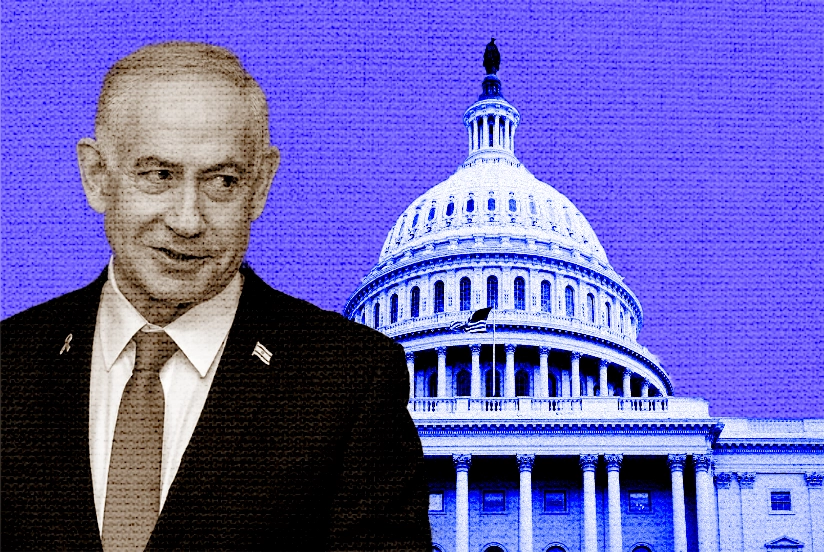
There is a common illusion, carefully maintained, that American foreign policy is shaped by national interest. The reality, particularly in the Middle East, is considerably less flattering. For decades, a single lobbying organisation — the American Israel Public Affairs Committee, known universally as AIPAC — has exercised an influence over Washington that virtually no other entity has come close to matching.
The organisation that would become AIPAC did not emerge from some orderly democratic process. It was forged in crisis.
In October 1953, Israeli soldiers under the command of Ariel Sharon massacred over sixty Palestinian civilians in the village of Qibya, drawing widespread international condemnation and prompting the Eisenhower administration to temporarily suspend economic aid to Israel. The diplomatic fallout alarmed pro-Israel activists in the United States, and their response was not to reckon with what had happened, but to organise more effectively against the political consequences of it.
I. L. Kenen, the operative who would build the lobby’s Washington infrastructure, wrote candidly at the time that the killings had “discredited the premises of our propaganda.”¹ His solution was not an attempt at reflection, but escalation.
Within months, the American Zionist Committee for Public Affairs was formally constituted, later renamed AIPAC. Simultaneously, the Conference of Presidents of Major American Jewish Organizations was established, creating what Rossinow describes as a durable “Jewish united front” capable of defending Israel regardless of what it did.² The pattern established then has never really changed.
Reward, Punish, Retreat
AIPAC’s power rests on a remarkably straightforward model. It rewards compliance and punishes dissent, operating across Congress, the White House, and increasingly the electoral system itself.
Formally registered as a domestic lobbying group, it functions, in the words of analyst Richard Curtiss, as an agent of the Israeli government operating under the cover of an American organisation.³
The mechanics are well documented. AIPAC maintains detailed scorecards on every member of Congress, tracking their votes on Israel-related legislation and distributing the results. It controls a network of over seventy pro-Israel Political Action Committees which, taken together, can channel staggering sums into electoral races.
It floods Capitol Hill with lobbyists, staffers, and unsolicited policy papers. Its annual Near East Report lands on every congressional desk, framing Middle Eastern politics in terms favourable to Israeli interests and identifying which politicians should be considered threats.
The consequences for dissent are severe and well documented. In the early 1980s, Illinois congressman Paul Findley was systematically destroyed politically after repeatedly advocating for Palestinian rights and recognition of the PLO. AIPAC mobilised and redirected money to his opponent, making it functionally impossible for Findley to fundraise. He lost by fewer than 1,500 votes and AIPAC took full credit.⁴
Consequently, the message to every other legislator was unmistakable. Even Senator Jesse Helms, a committed opponent of all foreign aid, reversed his position entirely after AIPAC poured money into his opponent’s 1984 campaign. He subsequently voted with AIPAC one hundred percent of the time.⁵
The Human Bill
If there was ever any ambiguity about AIPAC’s costs in human terms, the Israeli assault on Gaza that began in October 2023 has eliminated it. Since then, over 72,000 Palestinians have been killed, the vast majority civilians.⁶
Both the Biden and Trump administrations responded with unconditional military, financial, diplomatic, and political support, vetoing UN Security Council ceasefire resolutions on three separate occasions.
Total US aid to Israel between 1946 and 2023 reached approximately $158.6 billion, with an annual military assistance package of $3.8 billion locked in through 2028 — figures secured through sustained AIPAC pressure.⁷
The support to resist all of this was substantial. Gallup polling showed that by March 2024, only 36% of Americans approved of Israeli military operations, down from 50% just months earlier. However, public opinion didn’t seem to matter. Even though majorities of Democrats and independent voters actively opposed continued arms shipments, Congress moved in the opposite direction, approving a $26 billion Israel security package in 2024.
The mechanism behind such a profound detachment between public opinion and policy becomes clearer when you consider that AIPAC spent $100 million during the 2023-2024 congressional cycle specifically targeting Democratic incumbents who had expressed reservations about Israeli conduct.
For instance, progressive congressman Jamal Bowman, who voted against military aid packages, was defeated in his primary after AIPAC and allied groups spent over $14 million against him in a single New York district race.⁸
Thus, the gap between public opinion and American foreign policy on Gaza was never a mystery. It has always been a market outcome, where the price of opposing certain foreign policy positions has been set deliberately high.
The Loophole
The question most people never think to ask is a simple one: how is any of this legal? The answer lies in a piece of legislation written in 1938, designed to combat Nazi propaganda networks operating on American soil.
The Foreign Agents Registration Act, universally known as FARA, requires any person or organisation acting at the direction of a foreign government to register publicly with the Department of Justice. The intent was transparency. The result, in AIPAC’s case, has been something closer to a loophole.
AIPAC has never registered under FARA. Its predecessor organisation, the American Zionist Council, was ordered to do so in 1963 after investigators discovered it had been receiving the bulk of its operating funds from the Jewish Agency for Israel, a quasi-governmental body partly financed by the Israeli state.⁹
The AZC’s response was to dissolve itself and reconstitute as AIPAC, at which point the Justice Department withdrew its demand entirely. The rebrand was, in every meaningful sense, a legal escape hatch.
Since then, AIPAC has maintained its classification as a domestic advocacy group representing American citizens. Legally, this argument hinges on FARA’s central requirement: that an organisation must act at the “order, request, or under direction or control” of a foreign principal before the law applies.
Officially, AIPAC takes no formal instructions from Israel. It simply pursues policy positions that align with Israeli government priorities with remarkable consistency, facilitating congressional delegations to Israel, and channelling hundreds of millions of dollars into races that determine who makes American foreign policy. FARA was never designed to capture that kind of influence, and it shows.
Cracks in the Playbook
Something significant is shifting, though AIPAC’s leadership shows little sign of recognising it. For most of its history, the organisation operated in a political environment where support for Israel was genuinely bipartisan, where the costs of dissent were practically invisible to ordinary voters. That environment is eroding, and quite rapidly.
The share of Americans who view Israel favourably has fallen to a near-40-year low, according to Gallup data from early 2026. The war in Gaza accelerated a trend that was already underway as Israel’s government moved rightward under Netanyahu. Now with the Iran war, it seems like this trend is not ending soon.
Crucially, the scepticism has spread across party lines. Republicans, too, have begun to rethink ties, with some viewing them as incompatible with “America First” principles, regardless of Trump’s claim to own what the expression actually means. For an organisation whose power has always rested on bipartisan access, this represents a structural problem, and not merely a public relations one.
AIPAC’s response has been to double down while simultaneously trying to obscure what it is doing. As Israel’s conduct in Gaza made the organisation’s name politically toxic in some districts, AIPAC began operating through front groups with deliberately unremarkable names — organisations whose advertising made no mention of Israel whatsoever.
In New Jersey, for example, such groups targeted a candidate for voting with Trump and the Republicans to fund ICE, though the goal was to defeat a critic of Israeli policy without making the race about Israeli policy.¹⁰
Reform and Its Enemies
The obvious question, having traced AIPAC’s influence from the rubble of Qibya to the ruins of Gaza, is what serious reform would actually look like. The answer is reasonably clear, but the political reality is not.
FARA is the most obvious starting point. Its language is so outdated that it fails to capture the most consequential forms of foreign-aligned advocacy operating in Washington today. Stronger enforcement, clearer definitions of foreign direction, and genuine limitations on political engagement would all be necessary.
Yet the legislators who would need to pass such reforms are overwhelmingly the same legislators whose electoral survival has depended on remaining in AIPAC’s good graces. Asking Congress to dismantle the machinery that keeps its members in office is, historically, a request that goes unanswered.
What has changed is that the public is finally asking the question. The Mearsheimer and Walt thesis, presented in “The Israel Lobby and U.S. Foreign Policy” and dismissed as conspiracy theory when it appeared two decades ago, has returned to serious attention as events have made its central argument increasingly difficult to wave away. It turns out a war in Gaza, funded and shielded by Washington in defiance of both international law and majority American opinion, has a way of making previously uncomfortable arguments feel considerably more urgent.
Whether such a transformation in public opinion translates into political will is another matter entirely. Organised money, in American politics, has a remarkable record of outlasting public outrage. AIPAC, of all organisations, knows this better than anyone.
References
1. Rossinow, Doug (2018) “The Edge of the Abyss”: The Origins of the Israel Lobby, 1949–1954
2. Ibid. p.25
3. Curtiss, Richard H. (1990) “Stealth PACs: How Israel’s American Lobby Seeks to Control U.S. Middle East Policy.” 2nd ed. Washington, D.C: American Educational Trust
4. Findley, Paul (1989) “They Dare to Speak Out: People and Institutions Confront Israel’s Lobby.” Chicago, IL: Lawrence Hill Books, 1989.
5. Austin, Tanya R. (2006) Hijacking American Foreign Policy in the Middle East: An Analysis of the Power of the American Israel Public Affairs Committee
7. AlHawaneah, M. M. S., & Al-Ougili, M. A. S. (2026). “The Impact of AIPAC on US Foreign Policy Directions towards the Israeli War on the Gaza Strip (2023-2024).” Dirasat: Human and Social Sciences, 53(6), 9144. https://doi.org/10.35516/Hum.2026.9 144
8. Ibid
9. Estrella, Jeremy (2025) “Financial Power and Foreign Influence: How AIPAC Shapes U.S. Policy Beyond Public Opinion”
10. https://edition.cnn.com/2026/02/07/politics/aipac-new-jersey-malinowski-mejia


Leave a Reply