
There is a moment, every four years, when international football forces you to look away from the pitch and reckon with the organisation that runs it. The World Cup this year is one of those moments. More precisely, it is several of those moments stacked on top of each other, compressed into a single, deeply uncomfortable spectacle.
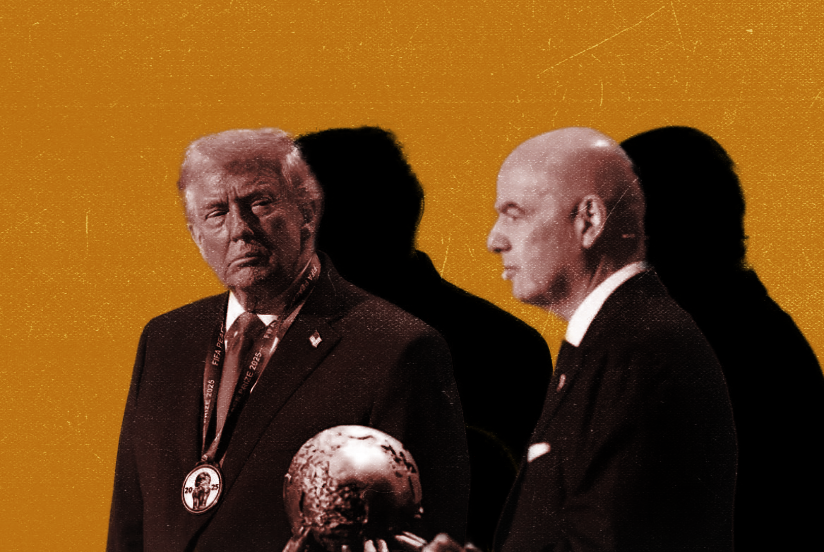
Last December, at the World Cup group stage draw held in Washington D.C., FIFA president Gianni Infantino awarded Donald Trump the inaugural “FIFA Peace Prize.” The ceremony was crowbarred into the event, presented with great solemnity.
At that point, Trump had already bombed Iran and several other countries, escalating tensions across the Middle East to a point where the entire world could see where things were heading. Nobody credibly believed this man was steering toward peace. Then, shortly after pocketing his shiny new prize, Trump orchestrated the kidnapping of Nicolás Maduro and oversaw a regime change in Venezuela. A remarkable début for a peace prize holder.
A Prize for the Shiny Object
The critical distinction here is between peace and peace prizes. Trump has long coveted the Nobel Peace Prize with a strange, almost theatrical desperation, and FIFA simply invented one to satisfy that vanity. This is a prize awarded because one powerful man wanted one, and a supplicant organisation obliged.
The logical endpoint of that logic is that a peace prize becomes a prop, a gilded certificate useful for ultra-populist propaganda, entirely stripped of its moral content. Infantino handed Trump a shiny object, and both men appeared deeply pleased with themselves.
By late February 2026, full-scale war between the US and Iran had begun. Iran, a qualified participant in the very tournament FIFA was busy promoting, was now at war with its co-host nation. Their decision to boycott is entirely sound. Why would any country travel to a host nation that is bombing it, to compete under the banner of a federation that publicly celebrated that host nation’s leader as a man of peace?
FIFA’s History of Looking Away
None of this emerges from nowhere. FIFA’s relationship with political convenience is well-documented and embarrassingly consistent. Russian officials were found to have engaged in bribery to secure the 2018 World Cup. Qatar’s 2022 bid carried similar allegations, alongside the well-publicised suffering of migrant workers who built its infrastructure. FIFA pressed forward regardless, in both cases, with the same rhetorical insistence that football transcends politics.
However, when Russia began its full-scale invasion of Ukraine, FIFA promptly banned it from international competition. Morally, that was the right call. Letting a nation engaged in a full-scale land invasion of a neighbouring country compete on the world stage would have been obscene. Yet honesty compels a harder question: had Russia’s full-scale invasion come in 2018, before the World Cup it had already been awarded, would FIFA have done the same thing?
The answer, given everything we know about the institution, is almost certainly no. The money was already committed, the infrastructure already built, and FIFA’s moral clarity has a well-established tendency to arrive only after the cheques have cleared, if it arrives at all. Principle, for this organisation, is ultimately situational. It bends reliably in the direction of revenue.
That is precisely why nothing will change now. The 2026 tournament will proceed, the contradictions will be politely ignored at an institutional level, and Infantino will continue his extraordinary performance of devotion toward the most powerful man in the room.
A Different Kind of Statement
What FIFA will not do, American fans and immigrant communities absolutely can. The World Cup arriving on US soil, in this particular political moment, carries a strange kind of opportunity alongside all its ugliness. Stadiums filled with people from across the world, including from countries Trump has sanctioned, bombed, or openly denigrated, represent something he cannot fully control. The warmth shown by immigrant communities toward the nations they came from, the simple act of welcoming the world without hostility — all of that constitutes a visible, public rebuttal to the administration hosting the tournament.
As for the FIFA Peace Prize itself, the concept deserves better than what it has been reduced to. It could mean something real if it were to be awarded to a grassroots football programme rebuilding communities in post-conflict societies, or to organisations genuinely using the game to provide young people with opportunities they would otherwise never see.
As things stand, its first recipient launched a war before the group stage. FIFA is an institution so intoxicated by proximity to money and power that it has lost the capacity to distinguish between legitimacy and flattery. Football deserves a governing body capable of that distinction. It has never had one, and in 2026, the gap between what football could be and what FIFA has made of it has never been wider or more embarrassing. After decades of what FIFA has consistently shown itself to be, I believe it has finally found its perfect ambassador. The prize fits the organisation. That, precisely, is the tragedy.


Leave a Reply