
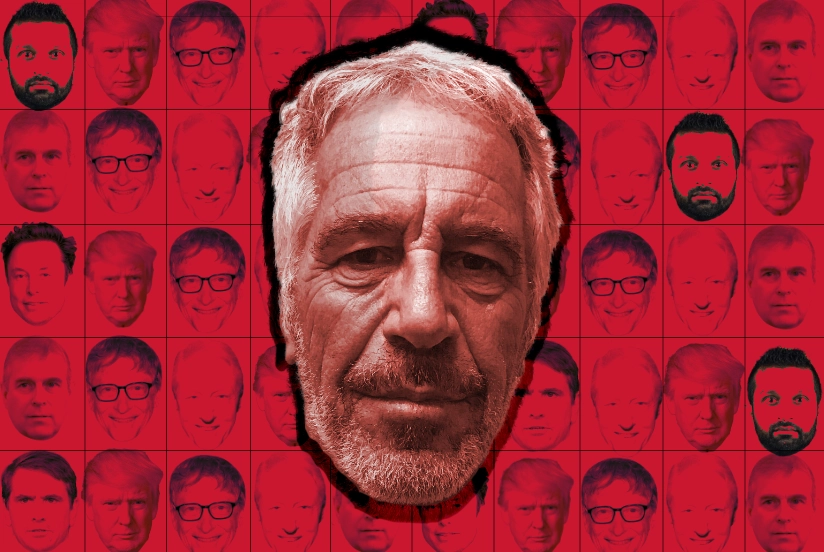
The latest release of the Epstein files does something more unsettling than confirm familiar suspicions about the political class of a number of countries. It clarifies the shape of political institutions that cannot meaningfully confront themselves.
It is clear that the millions of pages released late and largely redacted have done little to resolve the scandal, leaving the public with more questions than answers. Their most significant implication, however, lies elsewhere. They reveal that the institutions of American democracy have not merely struggled, but have actively failed to hold accountable individuals with well-established ties to Jeffrey Epstein, even long after his first conviction.
Since his 2019 arrest and subsequent death, Epstein has appeared to sit at the centre of this story, yet he may not be its true subject; power is. Power appears to shape what is brought into public view and what is carefully, deliberately sealed behind layers of redaction, protecting the reputations of the elites while leaving questions of accountability completely unresolved.
The entirety of the files reveals a stubborn, unmistakable proximity between Jeffrey Epstein and senior figures across political, financial, and institutional spheres. Various names surface repeatedly across social calendars, private correspondence, flight logs, and other second-hand accounts. Among them are Donald Trump, Bill Clinton, Prince Andrew, Elon Musk, Bill Gates, and Howard Lutnick, among others.

Taken together, the list spans current and former presidents, senior government figures, technology magnates, and media personalities. It traces a narrow band of individuals concentrated at the apex of political influence and capital accumulation.
Beyond the names that appear openly, numerous identities remain concealed behind redactions justified on grounds of “national security,” a rationale that itself suggests the involvement of additional figures whose exposure is deemed too consequential to permit.
At this point, the question ceases to be evidentiary and becomes civic. What, exactly, is supposed to happen now? What is the public meant to do with the knowledge that a documented child sex trafficker operated for decades inside the intimate social world of presidents, princes, billionaires, and intelligence-adjacent personalities, while the state signals that there will be no reckoning?
The answer has already been delivered, coldly and without any ounce of shame. Director of the FBI Kash Patel has stated that there is nothing to pursue. Attorney General Todd Blanche has gone further, announcing that no one named in the Epstein files will be charged, while adding, with breathtaking detachment, that “it is not a crime to party with Epstein.”
Taken together, these statements function as a public signal that the matter is closed, not because it has been resolved, but because resolving it would lead too far upward, too close to the centres of power that govern the country. This is how cover-ups now present themselves. Not through secrecy alone, but through blunt finality, delivered with the confidence of institutions that know they will not be challenged.
And the public, astonishingly, is expected to comply. To absorb the facts, register a moment of disgust, and then accept the instruction that follows every elite scandal. As Donald Trump himself has said, the country is expected to “move on.”
And so I ask you: are we meant to move on, now that we know children were abused within circles of immense power? Are we expected to look past the fact that those circles remain largely intact? Are we to accept, quietly, the growing evidence that accountability does not extend to those who occupy the highest tiers of global influence?
No, we should not move on. Not because outrage must be permanent, but because forgetting would be a decision rather than an inevitability. To move on would be to accept that power sets its own terms, that harm committed within its inner circles is negotiable, and that accountability is conditional. The question is no longer what we know, but what we are willing to live with knowing it.
The Epstein case has exposed the limits of American democratic institutions with unusual clarity. These institutions present themselves as custodians of justice and accountability, yet their handling of the Epstein files points to a more unsettling reality. They lack not only the capacity but also the willingness to confront abuses that originate within the powerful circles they routinely protect.
This failure is better understood as the product of alignment. Both parties appear entangled, and both benefit from silence. Both clearly understand the cost of genuine exposure. The bipartisan character of this case matters because it dissolves the lingering illusion that accountability can be passed upward through familiar political channels.
When power circulates within the same closed networks, untouched by electoral change, democratic institutions cease to stand as protections for the public. They become absorbers of pressure, carefully cushioning those at the top from consequence.
This case renders that reality with brutal efficiency. At no point does the machinery of democracy visibly turn toward those who were harmed, or toward a public still waiting for a truth it has every right to receive.
And yet, the implication is both devastating and strangely liberating. These institutions are not built to defend the public, but to preserve continuity, legitimacy, and elite stability. They treat the very reasonable popular outrage as a variable to be managed, not as a moral claim to be answered. The expectation that traditional democratic institutions would confront the moral failures and crimes involving powerful political and financial actors reflects a misunderstanding of their institutional role.
For that reason, this moment does not call for petitions addressed to structures that have already chosen silence, nor for appeals to figures who have long since closed ranks. It gestures toward a different horizon altogether. It calls for rupture. For an end to waiting and pleading, and to the useless ritual of asking power to restrain itself. This is an opening to withdraw consent from a system that has, by its own actions, made its priorities unmistakably clear.
Accountability never arrive as a gift. They are forced into being through organisation and our collective refusal to accept. History offers no examples of entrenched power dismantling itself out of conscience. Every genuine reckoning begins when people act together, persistently and visibly, outside the scripts handed to them.
Call it revolt if you like. Call it uprising, resistance, or refusal. What matters is its character. It must be collective, disciplined, and unyielding. It must draw its strength from solidarity and advance without seeking permission from traditional institutions that survive by denying it.
Thus, this is not a plea for reform addressed to those who profit from decay. It is an insistence on beginning anew. A recognition that accountability is never handed down as a concession from above. It must be constructed deliberately and relentlessly by us, by people who decide that life under this arrangement is no longer tolerable, and who choose, together, to refuse it.


Leave a Reply