
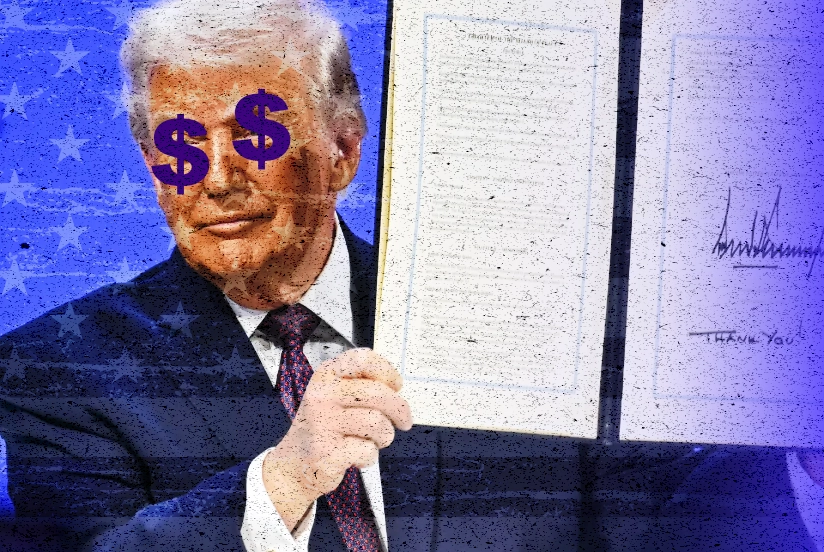
The recent creation of the Board of Peace has drawn attention for its unconventional structure. Central among it is a one-billion-dollar fee for permanent membership, a requirement that distinguishes the initiative from traditional multilateral institutions.
Beyond questions of representation and legitimacy, the proposal, which emerges from Donald Trump’s long-standing fixation on a peace prize, also raises more immediate practical concerns. The requirement of such a substantial financial contribution (one billion dollars) partially shifts attention away from who participates and toward what participation actually entails. In particular, it invites us to question how such a financial commitment is meant to translate into concrete outcomes. Thus, once the price of entry is paid, the more uncomfortable question follows: where exactly does the money go?
Although few states have confirmed whether they intend to pay for permanent membership, no transparent mechanism exists to explain how those funds would be managed or distributed. Given the sums involved, it is reasonable to question whether the initiative is in fact a diplomatic instrument, or merely a geopolitical revenue stream for Trump’s foreign policy.
From the outset, the fee makes clear that money is the primary measure of commitment. States enter the conversation having already demonstrated their value through wealth alone. Under this structure, the organisation’s actions function as returns on investment, as the presidents and dictators who pay for permanent membership expect concrete outcomes that advance their own objectives. In the process, any sense of collective obligation toward durable peace is displaced by individual interest. A framework built on these terms cannot credibly place peace at its centre.
It is logical to assume that in a forum where influence is tied to a financial contribution to Trump’s foreign policy, the payment itself risks translating into leverage. This concern is especially acute given that the Board of Peace was initially framed around the Israel–Palestine conflict, where the imbalances of power between the two inevitably skews the process. If one party is able to purchase access and influence, and has actively had the unconditional support of the creator and head of the organisation, the premise of neutrality is entirely undermined from the beginning.
So what is the money actually for? Armament and the upscale of an international order built on mass surveillance and control. Nevertheless, after a state transfers one billion dollars to join, what follows remains entirely unclear in terms of where it directly goes or what exactly happens to it. This uncertainty, however, is fundamentally political, and it is precisely the kind of ambiguity the United States has an interest in preserving. When money is collected without a clear pathway to use, it inevitably serves the priorities of whoever controls it.
In broad terms, ‘peace through strength’ is a foreign policy that treats overwhelming power as the primary condition for stability. The Board’s structure already fits comfortably within that framework. For instance, power already seems to be centralised, and military and economic leverage are already being used as stabilising forces by the United States to pursue imperialism, with little to no regard for accountability. Thus, the funds collected in the name of peace end up supporting demonstrations of dominance.
What happens to the money—where it is directed, through which accounts, and for what purposes—remains officially unknown. No published mechanism explains how the process unfolds in practical terms. There is no defined budget, no allocation model, and no timetable linking the payment to mediation, reconstruction, or humanitarian action. In the absence of transparency or accountability, the fee reinforces the impression that the Board treats the language of peace as a privately controlled political asset, leaving the one-billion-dollar question partially unanswered.


Leave a Reply